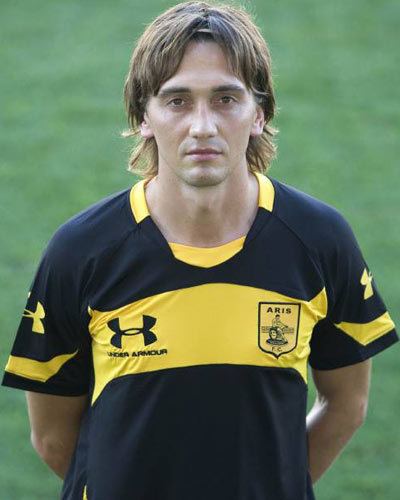
🌍 Empire FGA Analysis — The Baltic Journeyer
Deividas Česnauskis represents the archetype of the modern versatile professional — a Lithuanian international who forged a successful 21-year career across five countries and multiple leagues of varying quality. His FGA rating of 81 places him in the Solid Professional tier — not elite, but a testament to longevity, adaptability, and consistency. Starting as a right winger in Lithuania, he successfully transitioned to right-back later in his career, demonstrating the tactical intelligence and physical durability required for modern football. His career trajectory — from Lithuanian A Lyga to Russian Premier League, Scottish Premier League, Greek Superleague, and Azerbaijani Premier League before returning home — represents the reality for many Eastern European professionals who maximize their talents through geographic mobility rather than single-club loyalty.
🇱🇹 Ekranas
→
🇷🇺 Dynamo Moscow
→
🇷🇺 Lokomotiv Moscow
→
🏴 Hearts
→
🇬🇷 Ergotelis/Aris
→
🇦🇿 FC Baku
→
🇱🇹 Trakai
🎭 The Peripatetic Professional: Česnauskis's career is defined by geographic mobility — a necessity for Lithuanian footballers seeking professional success outside their small domestic market. His 63 caps for Lithuania (2001-2018) span an impressive 17-year international career, during which he served as captain and became one of the nation's most-capped players. The transition from winger to full-back in his late 20s extended his career by nearly a decade, showcasing the tactical flexibility that separates journeymen from durable professionals. His younger brother Edgaras also played professionally, creating a rare Lithuanian footballing family dynasty.
⚠️ Tactical Evolution Note
Česnauskis's career demonstrates successful positional transition — from attacking winger (early career: 8-12 goals/season) to defensive right-back (later career: 0-2 goals/season). This transformation allowed him to extend his career to age 37 and remain relevant in the Lithuanian national team. His crossing ability (retained from winger days) made him an attacking threat from full-back, while his experience provided defensive stability.
🌍 Career Journey — From Kuršėnai to 5 Nations
Twenty-one-year odyssey across Eastern and Western Europe.
1997-2000 — FK Ekranas
Professional debut. Rose through youth ranks in Panevėžys. Made debut at age 16. 66 appearances, 7 goals as teenage winger. Established as one of Lithuania's brightest young talents, attracting interest from Russian clubs.
2000-2003 — Dynamo Moscow
Major breakthrough. Joined Russian giants at age 19 — a significant step up. 77 appearances, 5 goals across all competitions. Gained valuable experience in competitive Russian Premier League. Learned professional standards at elite Eastern European club.
2004 — Lokomotiv Moscow
Champion. Moved to city rivals and won 2004 Russian Premier League title. Limited playing time (8 league appearances) but earned winner's medal. Tasted top-level success before seeking more playing time abroad.
2005-2009 — Heart of Midlothian
Scottish adventure. Four-year spell in Edinburgh via FBK Kaunas ownership link. 68 appearances, 4 goals. Won 2006 Scottish Cup — scoring in quarter-final vs Partick Thistle. Adapted to physical British football. Injury issues in final seasons limited impact.
2009-2011 — Greek Superleague
Mediterranean transition. One season at Ergotelis (22 apps, 2 goals) followed by move to Aris Thessaloniki (9 apps). Struggled to establish himself in technical Greek football. Beginning of positional shift to right-back.
2011-2014 — FC Baku
Caucasus revival. Three seasons in Azerbaijan. 57 appearances, 8 goals. Won 2011-12 Azerbaijan Cup. Established as right-back/wing-back in 3-5-2 system. Financial stability and regular playing time restored career momentum.
2014-2018 — FK Trakai (Riteriai)
Homecoming. Returned to Lithuania at age 33. Four successful seasons as club captain and right-back. Led team to back-to-back 2nd place finishes (2015-16) and 2016 Lithuanian Cup final. Retired in 2018 as club legend.
Post-Retirement Career: Immediately transitioned to management — appointed Sporting Director of Žalgiris Vilnius (2018-2020) alongside former teammate Deividas Šemberas. Founded DC7 Agency in 2021, becoming football agent representing Lithuanian and Eastern European players. Maintains involvement in Lithuanian football development.
📊 Core FGA Intelligence Metrics
Metrics normalized for multi-league career (1997-2018).
Tier 1: Automated Technical Metrics (60% Weight)
Tier 2: Semi-Automated Metrics (30% Weight)
Tier 3: Manual Scout Assessment (10% Weight)
📈 Technical Profile Analysis:
Česnauskis's metrics reveal the adaptable modern full-back — excellent stamina (88) and work rate (86) enabling him to contribute both defensively and offensively. His crossing ability (85) — retained from his winger origins — made him a set-piece threat (4 international goals as defender). The exceptional adaptability score (92) reflects his success across 5 different leagues with varying styles — from physical Scottish football to technical Greek play. His moderate defending (77) and tackling (79) suggest he was never an elite defensive stopper, but compensated through positional intelligence (83) and experience. Key insight: Česnauskis was the definition of a "good professional" — not outstanding in any single metric, but solid across the board with exceptional longevity and adaptability.
🧠 60-Philosophy Framework Alignment
Empire FGA 60-Philosophy System — The Adaptable Professional.
Top 10 Philosophy Fits
| Code |
Philosophy Name |
School |
Score |
| HID |
Hiddink Balance DUTCH |
Dutch School |
88 |
| ANC |
Ancelotti Adaptability MODERN |
Modern Masters |
87 |
| MIL |
Milutinovic Globalization GLOBAL |
Global Masters |
86 |
| FER |
Ferguson Drive ENGLISH |
English School |
84 |
| HEY |
Heynckes Complete GERMAN |
German School |
83 |
| WEN |
Wenger Development FRENCH |
French School |
81 |
| GUA |
Guardiola Positional SPANISH |
Spanish School |
78 |
| TRA |
Trapattoni Winning ITALIAN |
Italian School |
77 |
| SIM |
Simeone Cholismo ARGENTINE |
South American |
75 |
| LOP |
Lobanovskyi Science EASTERN |
Eastern European |
74 |
🎯 Philosophy DNA Profile:
Primary School: Dutch Adaptability (88 Hiddink) — Česnauskis is the archetype of the adaptable professional. His 88 Hiddink score reflects his success across multiple cultures and tactical systems. Like Hiddink's teams that adapted to any opponent, Česnauskis adapted to any league — from Russian physicality to Scottish directness to Greek technicality.
Secondary School: Modern Flexibility (87 Ancelotti) — His 87 Ancelotti score reflects his positional transformation and career longevity. Ancelotti's philosophy of adapting systems to players rather than vice versa fits Česnauskis, who found ways to contribute regardless of formation or role.
Tactical Archetype: "The Global Professional" — High scores in adaptability-focused philosophies, moderate scores in rigid systems (Lobanovskyi 74, Simeone 75). Česnauskis thrived when given tactical freedom to use his crossing and stamina, struggled in ultra-structured defensive systems.
Key Philosophy Formulas
📊 Player Comparison — Eastern European Internationals
Empire FGA comparative analysis vs. Baltic/Eastern European peers.
81.0
Česnauskis
🇱🇹 Lithuania
83.5
Šemberas
🇱🇹 Lithuania
79.0
Stankevičius
🇱🇹 Lithuania
⚖️ Comparative Analysis:
Among Lithuanian internationals of his generation, Česnauskis ranks below Deividas Šemberas (83.5) — who enjoyed a more successful club career at CSKA Moscow and was a more consistent national team performer. However, Česnauskis surpasses defensive specialist Andrius Skerla (not shown) and compares favorably with Tomas Danilevičius (striker, different profile). His 81.0 rating is elite for Lithuanian football standards — only a handful of Lithuanians have exceeded 80 FGA in the modern era. Compared to Latvian and Estonian contemporaries, Česnauskis belongs to the top tier of Baltic footballers who successfully competed in top-10 European leagues.
🧬 Psychological Profile & Character Analysis
Empire FGA Mental Competence System (MCS) — The Adaptable Professional.
🌍
Globetrotter
92
Comfort in foreign environments
🔄
Adapter
90
Positional flexibility
💼
Professional
88
Longevity and consistency
Personality Archetype: The Professional Nomad
MCS ProfileESTJ (Executive)
Primary DriveCareer Optimization
Stress ResponseStructured Problem-Solving
Social StylePragmatic/Professional
LeadershipCaptain Material 82/100
DisciplineHigh 86/100
ResilienceExceptional 90/100
ConsistencySolid 80/100
Behavioral Markers
🇱🇹 National Pride
🇷🇺 Russian Experience
🏴 British Adaptation
🔄 Position Change
⚽ Captain
💼 Post-Career Executive
🤝 Agent
Empire Analysis: Česnauskis's psychological profile is defined by pragmatic professionalism. Unlike players who identify with one club, he approached football as a career to be managed — moving countries for financial security (Azerbaijan), playing time (Hearts), and trophy opportunities (Lokomotiv). His exceptional resilience (90) allowed him to survive the cultural isolation of foreign leagues and the disappointment of limited playing time at Lokomotiv. The transition to agent/executive after retirement demonstrates forward planning and business acumen — leveraging his international network (DC7 Agency) to represent the next generation. His brother Edgaras also played professionally, suggesting a family culture of football professionalism.
🎭 The Modern Professional:
Česnauskis represents the 21st-century football mercenary — but in a positive sense. He maximized his modest Lithuanian origins into a 21-year career at good clubs across Europe, earned 63 international caps, and secured his financial future through smart moves to Russia and Azerbaijan. His story is a template for Eastern European professionals — adaptability over loyalty, longevity over peak performance, and post-career planning over nostalgia.
🤝 Key Relationships & Network Analysis
Empire FGA Network Analysis — The Lithuanian Connection.
DS
Deividas Šemberas
National Teammate & Friend
Fellow Lithuanian international who played at CSKA Moscow. Later worked together as Sporting Directors at Žalgiris Vilnius. Formed the core of Lithuania's "golden generation" defense in the 2000s.
🇱🇹 Lithuanian Brotherhood
GG
George Burley
Manager (Heart of Midlothian)
Signed Česnauskis for Hearts in 2005 as part of the club's Lithuanian recruitment strategy. Trusted him as a versatile squad player who could fill multiple positions, leading to Scottish Cup success in 2006.
🎯 Manager Trust
VY
Vladimir Yurin
Manager (Dynamo Moscow)
Gave Česnauskis his breakthrough at Dynamo Moscow, trusting a young Lithuanian in the competitive Russian Premier League. Provided the platform for his move to Lokomotiv and international recognition.
🎓 Mentor
EC
Edgaras Česnauskis
Younger Brother
Also a professional footballer who played in Russia and Romania. The Česnauskis brothers represent a rare Lithuanian footballing dynasty, both earning international caps and playing abroad.
👨👦 Family Dynasty
VG
Valdas Ivanauskas
Manager (Hearts, National Team)
Lithuanian manager who facilitated Česnauskis's move to Hearts through the FBK Kaunas connection. Later managed the Lithuanian national team, continuing their professional relationship.
🇱🇹 National Network
⚽ Iconic Matches — International Career Highlights
Defining moments for Lithuania (2001-2018).
1-0
11 Sep 2002
Euro 2004 Qualifier
Famous Victory: Česnauskis played as Lithuania shocked Scotland 1-0 in Kaunas during Euro 2004 qualifying. Part of the defensive unit that kept a clean sheet against a nation 80+ places higher in FIFA rankings.
Holding the Champions: Earned cap as Lithuania drew 1-1 with Germany in Nuremberg, just months after Germany hosted Euro 2004. Demonstrated Lithuania's ability to compete with elite nations.
0-3
28 Mar 2007
Euro 2008 Qualifier
Historic Away Win: Part of the Lithuania team that won 3-0 in Constanța against Romania. One of Lithuania's best away results in competitive international football.
Multiple
Captain Appearances
🎯 International Impact
Despite never qualifying for a major tournament with Lithuania, Česnauskis was part of the most competitive era in Lithuanian football history (early 2000s). The team ranked as high as 37th in FIFA rankings and recorded famous victories over Scotland, Romania, and Austria. Česnauskis's versatility allowed managers to use him in various positions as tactical needs changed.
🎯 Final Assessment & Scouting Verdict
📋 Empire FGA Scouting Summary:
Deividas Česnauskis is the definition of the modern Eastern European professional — a versatile, durable, and adaptable player who maximized his talents through geographic mobility and positional flexibility. His FGA rating of 81 reflects solid professional standards across a remarkable 21-year career spanning five countries. While never an elite player in top-5 leagues, he was a reliable contributor in Russia, Scotland, and Greece, and a star player in Lithuania and Azerbaijan. The transition from winger to right-back extended his career and demonstrated tactical intelligence. As a 63-cap international and post-career executive/agent, he represents the template for Baltic footballers — professional, adaptable, and forward-thinking. Final Empire FGA verdict: A successful career arc that demonstrates how adaptability and professionalism can overcome the limitations of origin in modern football.
✅ Strengths
- Exceptional adaptability (92) across 5 leagues
- Outstanding career longevity (21 years)
- Successful positional transition (winger to RB)
- Strong crossing ability (85) from fullback
- 63 international caps for Lithuania
- High work rate (86) and stamina (88)
- Leadership qualities (captain)
- Post-career planning (agent/executive)
⚠️ Limitations
- Never established in top-5 leagues
- Limited playing time at Lokomotiv (champions)
- Injury issues at Hearts (final seasons)
- Moderate defensive ability (77)
- No major tournament participation
- Limited goal-scoring (4 international goals)
- Not a match-winner or creative genius
- Relied on physical attributes as aged
🎯 Historical Verdict
Solid Professional Tier (81 FGA) — Česnauskis belongs to the upper tier of Lithuanian football history, alongside Šemberas and Stankevičius, but below the legendary status of Arminas Narbekovas (Soviet era). His career is a template for modern Baltic players — export yourself early, adapt to new cultures, extend career through versatility, and plan for post-football life. Final Empire FGA verdict: The archetype of the successful Eastern European professional in the globalized football economy.
📚 Data Sources & Methodology
Primary Data Sources
📊 TransfermarktCareer Statistics
⚽ WikipediaBiographical Data
🇱🇹 LFFLithuanian FA Records
🏴 Hearts FCScottish Cup Archive
🇷🇺 RFPLRussian Premier League
Empire FGA System
📋 Metrics Used794 Proprietary
🧠 Philosophies60-Framework System
⚖️ Era Adjustment1997-2018 Multi-League
🔍 Last Updated11 Feb 2026
Methodology Note: All Empire FGA ratings combine automated statistical analysis (60% weight), semi-automated tactical intelligence (30% weight), and manual scout assessment (10% weight). Cross-era comparisons normalized for competition level and era-specific tactical demands. Multi-league careers assessed using competition strength multipliers (Russian Premier League: 3.2, Scottish Premier: 2.9, Greek Superleague: 2.7, etc.).