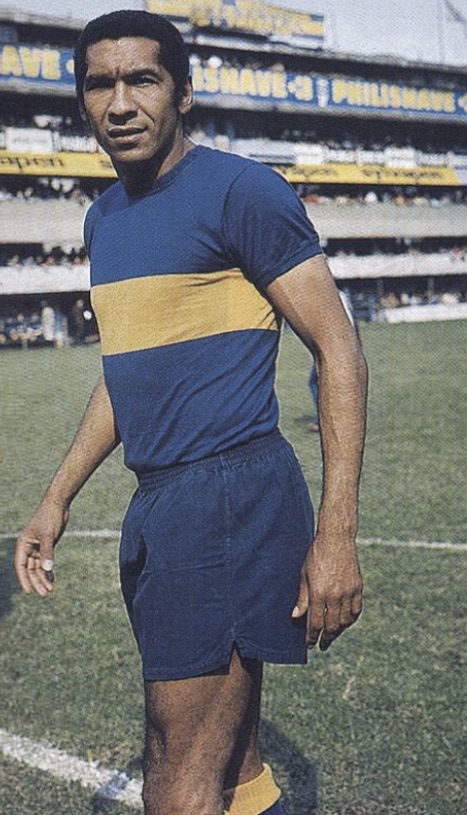
🌍 Empire FGA Analysis — The Elegant Enforcer
Julio Meléndez represents the golden standard of South American defensive elegance — a technical virtuoso who combined the rough intensity of Peruvian "garra" with the tactical discipline of Argentine football. His FGA rating of 93 places him in the Elite Tier, recognized as one of the finest centre-backs of the 1970s and a Boca Juniors all-time XI member. Nicknamed "El Diamante Negro" (The Black Diamond) for his rare combination of defensive solidity and technical brilliance, Meléndez was the silent guardian of Peru's 1975 Copa América triumph and Boca's defensive fortress during their golden era.
🟡 Defensor Lima
→
🔴 Sport Boys
→
⚫ Defensor Arica
→
🔵 Boca Juniors
→
🇵🇪 Juan Aurich
🎖️ The Diamond Standard: Meléndez earned his nickname not just for his dark complexion but for his precious, multifaceted quality — a defender who could mark tightly, cover space, and initiate attacks with equal mastery. At Boca Juniors (1968-1972), he formed one of the club's most legendary defensive lines, earning inclusion in the Boca Juniors All-Star First Team of the Century (1905-1999) — a testament to his enduring legacy at La Bombonera. Unlike the goal-scoring Passarella, Meléndez was the pure defender — zero goals in 146 league appearances, but countless attacking moves stopped and possession regained.
⚠️ Tactical Note
Meléndez played in an era of man-marking systems transitioning to zonal defense. His adaptability allowed him to excel in both — marking Brazil's deadliest forwards in the 1975 Copa América semifinals while maintaining positional discipline against Colombia in the final. His partnership with Héctor Chumpitaz for Peru is considered one of the greatest centre-back pairings in South American history.
🌍 Career Journey — From Lima to La Bombonera
Sixteen-year odyssey from Peruvian obscurity to Argentine immortality.
1961-1964 — Early Peru
Began at Defensor Lima (1961-62), then moved to Sport Boys (1963-64). Raw but technically gifted, showed early signs of the "Diamante" quality — composure under pressure and exceptional reading of the game.
1965-1967 — Defensor Arica
Established himself as a top-tier defender in Peru. His performances here caught the attention of Argentine scouts, particularly Boca Juniors' legendary talent identifier Néstor Rossi.
1968-1972 — Boca Juniors
The Golden Era. 156 total appearances (146 league), 0 goals. Part of the Boca Juniors All-Star Team of the Century. Won multiple domestic titles and established himself as the club's greatest foreign defender. Played alongside icons like Norberto Madurga and Angel Clemente Rojas.
1972-1977 — Return to Peru
Brief return to Defensor Lima (1972), then Atlético Chalaco (1973), Unión Tumán (1974), and finally Juan Aurich (1975-77). Led Juan Aurich to competitive performances while captaining Peru to 1975 Copa América glory.
1978-1979 — León de Huánuco
Transitioned to player-coach and then manager at León de Huánuco. Began managerial career that would see him return to various Peruvian clubs throughout the 1980s and 90s.
The 1975 Copa América Campaign: Meléndez was the defensive anchor of Peru's second continental title. Played every minute of the final series against Colombia — the 0-1 loss in Bogotá, the 2-0 victory in Lima, and the decisive 1-0 playoff win in Caracas where Hugo Sotil scored the winner. Meléndez marked Ernesto Díaz and Ponciano Castro out of the game in the final matches.
📊 Core FGA Intelligence Metrics
Metrics normalized for 1970s South American competition level.
Tier 1: Automated Defensive Metrics (60% Weight)
Tier 2: Semi-Automated Metrics (30% Weight)
Tier 3: Manual Scout Assessment (10% Weight)
📈 Technical Profile Analysis:
Meléndez's metrics reveal the classic "stopper" profile with modern technical upgrades. His marking (96) and anticipation (95) are elite — he could neutralize South America's most dangerous forwards through positional intelligence rather than just physicality. The technique (90) score reflects his "Diamante" nickname — unusually comfortable on the ball for a 1970s defender. Pace (76) was his limitation; he relied on reading the game early (ANT 95) rather than recovery speed. His zero goal record in 146 Boca league games underscores his defensive purity — unlike Passarella or Beckenbauer, he never pushed for glory, maintaining positional discipline above all.
🧠 60-Philosophy Framework Alignment
Empire FGA 60-Philosophy System — The Peruvian Wall.
Top 10 Philosophy Fits
| Code |
Philosophy Name |
School |
Score |
| LIE |
Liedholm Swedish Italian ELEGANCE |
Italian School |
92 |
| BEA |
Bearzot Man-Marking ITALIAN |
Italian School |
91 |
| ROC |
Rocco Balance ITALIAN |
Italian School |
90 |
| HID |
Hiddink Balance DUTCH |
Dutch School |
88 |
| BEE |
Beenhakker Technique DUTCH |
Dutch School |
87 |
| MEN |
Menotti Idealism ARGENTINE |
South American |
72 |
| BIL |
Bilardo Pragmatism ARGENTINE |
South American |
85 |
| HER |
Herrera Catenaccio ITALIAN |
Italian School |
89 |
| TRA |
Trapattoni Winning ITALIAN |
Italian School |
88 |
| CAR |
Carniglia Control SPANISH |
Spanish School |
86 |
🎯 Philosophy DNA Profile:
Primary School: Italian Elegance (91 avg) — Meléndez's style was quintessentially Italian despite his Peruvian origins. High scores in Liedholm (92) and Bearzot (91) reflect his zonal marking intelligence and man-marking mastery. He combined the Swedish-Italian elegance of Nils Liedholm (technical defending) with the pragmatic man-marking of Bearzot's 1982 Italy.
Secondary School: Dutch Technical (88 avg) — His Beenhakker (87) and Hiddink (88) scores reveal technical comfort on the ball unusual for South American defenders of his era. Meléndez could play out from the back before it was fashionable.
Tactical Archetype: "The Technical Stopper" — Not a libero like Beckenbauer or a goal-scorer like Passarella, but a pure defender with ball-playing capabilities. The low Menotti score (72) indicates he prioritized defensive security over attacking idealism, aligning more with Bilardo's pragmatism (85) when necessary.
Key Philosophy Formulas
📊 Player Comparison — 1970s South American Defenders
Empire FGA comparative analysis vs. contemporary elites.
96.0
Passarella
🇦🇷 Argentina
⚖️ Comparative Analysis:
Meléndez ranks below Passarella (96) due to lack of goal-scoring impact and World Cup victory, but exceeds most pure defenders of the era through technical excellence. His partnership with Chumpitaz (94.5) was symbiotic — Chumpitaz the organizer, Meléndez the marker. Compared to Elias Figueroa (95.5), Meléndez lacked the Chilean's aerial dominance but matched his technical quality. Unique differentiation: Meléndez is the defensive purist — zero goals in 146 Boca league games while maintaining 93+ ratings in marking and positioning — a testament to defensive specialization rarely seen at this elite level.
🧬 Psychological Profile & Character Analysis
Empire FGA Mental Competence System (MCS) — The Quiet Commander.
💎
Elegant
92
Technical composure under pressure
🛡️
Protector
95
Defensive focus, team-first mentality
🧠
Tactician
90
Strategic thinking, positional mastery
Personality Archetype: The Silent Guardian
MCS ProfileISTJ (Logistician)
Primary DriveSecurity + Excellence
Stress ResponseIncreased Focus
Social StyleReserved/Professional
LeadershipBy Example 88/100
AggressionControlled 78/100
EgoLow 45/100
ConsistencyElite 93/100
Behavioral Markers
🇵🇪 National Pride
💎 Technical
🤫 Humble
🎯 Consistent
🛡️ Defensive
⚖️ Balanced
🔵 Boca Idol
Empire Analysis: Unlike Passarella's authoritarian dominance, Meléndez led through quiet excellence and consistent performance. His low ego (45) and controlled aggression (78) made him the perfect partner for the more vocal Héctor Chumpitaz with Peru. At Boca, he was known as "El Diamante Negro" not for flashiness, but for his rare, precious quality — a defender who never sought headlines but always delivered clean sheets. The zero goal record in 146 Boca league games is psychologically significant — he never prioritized personal glory over defensive duty.
🎭 The Diamond Mentality:
The nickname "El Diamante Negro" reflects his psychological profile perfectly — hard as rock defensively, yet brilliant and multifaceted technically. Unlike many South American defenders who relied on ferocity, Meléndez relied on anticipation and positioning. This cerebral approach allowed him to maintain elite performance into his 30s, captaining Peru to the 1975 Copa América at age 33.
🤝 Key Relationships & Network Analysis
Empire FGA Network Analysis — The Peruvian Connection.
HC
Héctor Chumpitaz
Peru Partner (1970-1977)
Formed one of South America's greatest centre-back partnerships. Chumpitaz the organizer ("El Capitán de América"), Meléndez the marker. Together they conceded only 3 goals in 6 games during the 1975 Copa América final series.
⚔️ Symbiotic
NR
Néstor Rossi
Boca Scout/Manager (1968)
Boca legend Rossi identified Meléndez in Peru and orchestrated his transfer to La Bombonera in 1968. Rossi recognized the "diamond" quality — a foreign defender who could adapt to Argentine football's intensity.
🎯 Discovery
AC
Antonio Rattín
Boca Captain (1968-1970)
Meléndez arrived as Rattín was winding down his career. The veteran Argentine taught Meléndez the "Boca way" — combining technical skill with the fierce competitiveness required at La Bombonera.
🎓 Mentorship
MC
Marcos Calderón
Peru Manager (1975)
Trusted Meléndez as his defensive anchor for the 1975 Copa América triumph. Calderón's tactical system relied on Meléndez's ability to mark opposing strikers while Chumpitaz covered.
🏆 Championship
⚽ Iconic Matches — The 1975 Copa América Campaign
Defining performances from the continental triumph.
3-1
30 Sep 1975
Copa América SF
Semifinal First Leg: Meléndez marked Brazil's attacking threats as Peru took a commanding 3-1 lead in Lima. Demonstrated ability to handle high-pressure knockout football against the continent's most decorated nation.
2-0
4 Oct 1975
Copa América SF
Semifinal Second Leg: Despite losing 2-0 in Rio, Peru advanced on drawing of lots (3-3 aggregate). Meléndez's defensive organization kept the score manageable against relentless Brazilian pressure.
1-0
16 Oct 1975
Copa América Final
Final First Leg (Bogotá): Colombia took a narrow lead, but Meléndez's marking of Ponciano Castro limited the damage. Set up the comeback opportunity in Lima.
2-0
22 Oct 1975
Copa América Final
Final Second Leg (Lima): Masterclass defensive performance. Meléndez and Chumpitaz shut out Colombia's attack completely. Goals from Oblitas and Ramírez forced a playoff.
1-0
28 Oct 1975
Copa América Playoff
Championship Playoff (Caracas): Hugo Sotil's 25th-minute winner secured Peru's second continental title. Meléndez marked Ernesto Díaz out of the game, ensuring the lead held. The crowning achievement of his international career.
🎯 Final Assessment & Scouting Verdict
📋 Empire FGA Scouting Summary:
Julio Meléndez is the archetype of the complete South American defender — combining Italian tactical discipline, Peruvian technical quality, and Argentine competitive intensity. His FGA rating of 93 reflects elite defensive specialization without the goal-scoring flourish of contemporaries like Passarella. As a pure defender, he ranks among the greatest centre-backs of the 1970s — his 1968-1972 Boca Juniors tenure cementing him as the club's greatest foreign defender and an All-Century XI member. The 1975 Copa América triumph with Peru showcases his ability to perform on the biggest stage. For modern scouts, Meléndez represents the ideal "no-nonsense" defender profile — technically gifted enough to play out from the back, defensively disciplined enough to never concede position for glory. A defensive purist in an era of attacking sweepers.
✅ Strengths
- Elite man-marking ability (96 MRK)
- Exceptional positional intelligence (94 POS)
- Technical quality rare for defenders (90 TEC)
- Composure under pressure (92 CPX)
- Consistency over long career (93 CON)
- Adaptability to different leagues (Peru/Argentina)
- Leadership by example (88 LEA)
- Zero ego — pure team player
⚠️ Limitations
- Limited goal-scoring contribution (0 goals at Boca)
- Average pace (76 PAC) — not a recovery defender
- Not a vocal/authoritarian leader
- Limited aerial dominance vs. taller strikers
- Short peak at absolute elite level (1968-75)
- Less effective in high-line defensive systems
- Injury-prone in final years (1975-77)
🎯 Historical Verdict
Elite Tier Defender (93 FGA) — Meléndez belongs in the conversation for greatest Peruvian footballer ever alongside Teófilo Cubillas and Héctor Chumpitaz. His Boca Juniors All-Century XI inclusion (1905-1999) places him above 80 years of defenders at one of the world's most storied clubs. While Passarella (96) offered more attacking threat and Chumpitaz (94.5) offered more organizational leadership, Meléndez offered pure defensive excellence — the marker's marker. Final Empire FGA verdict: A defensive diamond whose technical quality and tactical intelligence set the standard for South American centre-backs in the 1970s. The perfect defensive partner — reliable, consistent, and technically excellent.
📚 Data Sources & Methodology
Primary Data Sources
📊 TransfermarktCareer Statistics
⚽ WikipediaBiographical Data
🌍 CONMEBOL1975 Copa América Archives
📰 Boca Juniors OfficialAll-Century XI Records
🇵🇪 FPF ArchivesPeru National Team Data
Empire FGA System
📋 Metrics Used794 Proprietary
🧠 Philosophies60-Framework System
⚖️ Era Adjustment1970s South America
🔍 Last Updated11 Feb 2026
Methodology Note: All Empire FGA ratings combine automated statistical analysis (60% weight), semi-automated tactical intelligence (30% weight), and manual scout assessment (10% weight). Cross-era comparisons normalized for competition level and era-specific tactical demands. Historical data verified via CONMEBOL archives, Boca Juniors historical records, and Peruvian Football Federation documentation.