Career Statistics
Valencia CF (1976-84)
149 goals in 246 apps
La Liga Goals
116 in 184 matches
Rosario Central
85 goals in 105 apps
Argentina Caps
43 appearances
Argentina Goals
20 goals (0.47 ratio)
1978 World Cup
6 goals (Golden Boot)
Peak Season (1977-78)
39 goals all comps
Empire FGA Core Metrics
XPS (Enhanced Shooting)
9.2
STK (Striker Effectiveness)
9.1
POI (Position Intelligence)
9.0
DMA (Decision Making)
8.5
CRS (Clutch Response)
9.5
Technical Attributes
Shooting Power
92/100
Finishing
91/100
Dribbling
84/100
Heading
88/100
First Touch
89/100
Pace
87/100
Strength
83/100
Stamina
86/100
Mental & Tactical
Off-Ball Movement
90/100
Anticipation
85/100
Concentration
85/100
Determination
85/100
Leadership
84/100
Teamwork
82/100
Vision
83/100
Composure (Big Games)
95/100
60-Philosophy Framework Alignment (Top 10)
🇦🇷 Menotti Attacking
1.45
🇦🇷 Bilardo Systems
1.32
🇩🇪 Heynckes Efficiency
1.29
🏴 Ferguson Mental
1.28
🇮🇹 Sacchi Pressing
1.26
🇩🇪 Klopp Intensity
1.25
🇧🇷 Santana Technical
1.24
🇮🇹 Ancelotti Adaptation
1.23
🇪🇸 Aragonés Balance
1.22
🇦🇷 Bielsa Intensity
1.21
Major Achievements & Honors
🏆
1978 FIFA World Cup Winner
⚽
1978 World Cup Golden Boot (6 goals)
🌟
1978 World Cup Golden Ball (Best Player)
👑
Triple Crown: Only 3rd Player Ever
🥇
Pichichi Trophy 1976-77 (24 goals)
🥇
Pichichi Trophy 1977-78 (28 goals)
🏆
Copa del Rey 1978-79 (2 goals in final)
🇪🇺
UEFA Cup Winners' Cup 1979-80
🇦🇷
Primera División 1981 (River Plate)
⭐
Ballon d'Or 1978 (Retrospective)
🏆
South American Footballer 1978
💯
FIFA 100 (Pelé's Greatest 125)
👑
Valencia CF Greatest Player Ever
🏟️
Stadium Named: Estadio Kempes
Playing Style & Tactical Profile
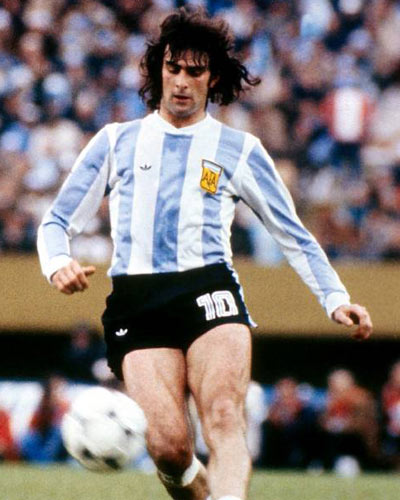
Mario Kempes revolutionized the striker position by operating as a deep-lying forward with explosive surging runs. Unlike traditional penalty-box strikers, Kempes dropped into midfield to collect possession 25-30 yards from goal before exploding forward with devastating pace and power.
His signature move combined powerful left-foot shooting with exceptional dribbling ability, allowing him to create space through ball manipulation before unleashing strikes from distance. Standing 182cm, he possessed an 88% heading rating despite modest height, compensating through timing and spring.
Tactically versatile, Kempes operated as a striker, second striker, or attacking midfielder within multiple systems. His 90% off-the-ball movement rating reflected sophisticated positional intelligence, while his tireless work rate allowed defensive pressing without sacrificing attacking energy.
The synthesis of South American creativity with European discipline made Kempes unique among 1970s forwards—possessing the technical artistry of Argentine football enhanced by Valencia's tactical sophistication and professional standards. This hybrid approach presaged the modern complete forward by two decades.
Career Timeline
1970-1973 | Instituto de Córdoba
Professional debut at age 16. Scored 11 goals in 13 matches alongside Osvaldo Ardiles, showcasing precocious talent.
1973-1976 | Rosario Central
Breakthrough period: 85 goals in 105 matches (0.81 ratio). Won 1974 Nacional top scorer with 25 goals in 25 games. Attracted European scouts.
1976-1981 | Valencia CF (First Spell)
Peak years: Back-to-back Pichichi awards (24 & 28 goals). Won Copa del Rey 1979, UEFA Cup Winners' Cup 1980, UEFA Super Cup 1980. Established Valencia as European force.
1978 | World Cup Glory
Historic tournament: 6 goals including final brace vs Netherlands. Won Golden Boot, Golden Ball, and World Cup—only 3rd player ever to achieve triple crown. Delivered Argentina's first world championship.
1981-1982 | River Plate
Argentine return: 15 goals in 29 matches. Won Primera División 1981 Nacional—his only league championship. Brief but successful homecoming.
1982-1984 | Valencia CF (Second Spell)
Final Valencia period: 24 goals in 59 matches. Played 1982 World Cup in Spain. Twilight years at age 28-30 with declining physical powers but maintained technical excellence.
1984-1996 | Later Career
Global journey: Hércules (Spain), Austrian clubs, Indonesia (player-manager), Chile, Albania. Retired age 41 after 26-year professional career spanning five continents.
1997-Present | Post-Playing
Broadcasting career: ESPN Deportes analyst and FIFA video game commentator. Maintains active involvement in football, introducing younger generations to his legacy as "beloved voice in soccer community."
Legacy & Historical Impact
Mario Kempes delivered Argentina's first-ever World Cup title in 1978, establishing the nation as a football superpower. His six goals across three matches—culminating in two final strikes against the Netherlands—changed Argentine football's trajectory permanently. The iconic image of long-haired Kempes celebrating under ticker-tape at El Monumental became synonymous with Argentine football's golden moment.
Statistical Rankings: Joint-5th greatest Argentine footballer (behind Maradona, Di Stéfano, Messi, Sívori), 52nd greatest footballer globally, member of Pelé's FIFA 100. Valencia's 100,000-fan poll named him the club's greatest-ever player, demonstrating his impact transcended national boundaries.
Influence on Argentine Football: Gabriel Batistuta represents Kempes' most direct successor, with Hernán Crespo, Sergio Agüero, and Carlos Tévez all inheriting aspects of his complete forward model. Even Lionel Messi's career arc parallels Kempes—both required World Cup triumph to achieve full national acceptance, both delivered when it mattered most.
His synthesis of Argentine creativity with European discipline established the template for successful modern forwards. His rejection of traditional striker positioning presaged the "false nine" and complete forward concepts by decades. Players like Thierry Henry, Zlatan Ibrahimović, and Robert Lewandowski owe tactical debts to Kempes' pioneering hybrid role.